Canyonlands National Park Information Guide

Welcome to the Canyonlands National Park Information Guide.
Here you will find all you need to know about the natural history of the park.
Learn about the geology, trees, mammals, birds, or other plants and wildlife of the area.

-SPONSORED LINKS-
Utah Lodging
Utah Hotels
Utah Maps
Utah Camping
Utah Weather
Utah Vacation Rentals
The Mushrooms - Corel ©

Sponsored National Park Search

Canyonlands National Park Information

  • Canyons
  • Establishment
  • Flora & Fauna
  • Geology
  • History
  • Size & Visitation

  • 
    

    Establishment

    Public awareness of the scenic canyon country likewise expanded, mostly due to the efforts of Arches National Monument Superintendent Bates Wilson. Wilson first visited the area by horse in 1951, riding to the Confluence and up Salt Creek. His early mapping of archeological sites in Salt Creek and Horse Canyon spurred the interest of University of Utah archeologists. Wilson worked from 1951 to 1955 for an official National Park Service investigation of the area. In 1957 he began leading visitors into the Canyonlands area, publicizing its scenic and recreational values, and recommending the creation of a "Grand View National Park." Secretary of the Interior, Stewart Udall, visited the area in 1961, and began campaigning for a national park on what were then Bureau of Land Management lands.

    With the enthusiasm, guidance and foresight of people such as former Secretary of the Interior Stewart L. Udall, Bates Wilson, Slim Mabery, Kent Frost and many others, the heart of the canyon country was preserved as Canyonlands National Park. On 12 September 1964, President Lyndon B. Johnson signed legislation establishing the first Park since 1956. In 1971, President Richard Nixon signed into law an expansion of the park to its present size of 527 square miles.


    Size and Visitation

    Canyonlands National Park, consisting of 257,640 acres. The park was expanded in 1971 to its present 337,570 acres, or 527 square miles.

    In order to preserve an area in the State of Utah possessing superlative scenic, scientific, and archeologic features for the inspiration, benefit, and use of the public, there is hereby established the Canyonlands National Park which, subject to valid existing rights, shall comprise the area generally depicted on the drawing entitled "Boundary Map, Canyonlands National Park, Utah", numbered 164-91004 and dated June 1970, which shows the boundaries of the park having a total of approximately three hundred and thirty-seven thousand two hundred and fifty-eight acres. The map is on file and available for public inspection in the offices of the National Park Service, Department of the Interior.

    The majority of park visitors come during Spring and Fall and are lowest in December through March. The park is open 24 hours a day, seven days a week.


    History

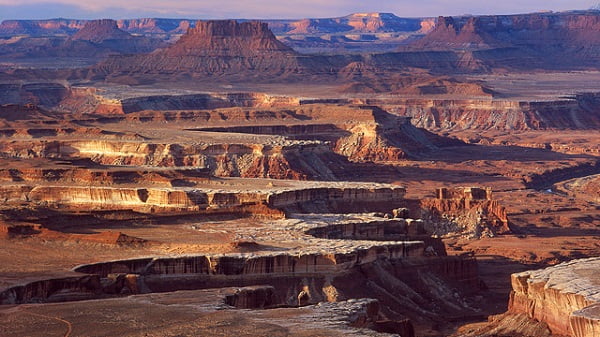
    Canyonlands preserves an immense wilderness of rock at the heart of the Colorado Plateau. Water and gravity have been the prime architects of this land, cutting flat layers of sedimentary rock into hundreds of colorful canyons, mesas, buttes, fins, arches and spires. At center stage are two great canyons, those carved by the Green and Colorado rivers. Surround the rivers are vast and very different regions of the park: to the north, Island in the Sky; to the west, the Maze; and to the east, the Needles. The areas share a common primitive spirit and wild desert atmosphere. Each also offers its own special rewards. Few people were familiar with these remote lands and rivers when the park was established in 1964. Prehistoric Native Americans, cowboys, river explorers and uranium prospectors had dared to enter this rugged corner of south-eastern Utah, but few others did. To a large degree, Canyonlands remains untrammeled today. Its roads are mostly unpaved, its trails primitive, its rivers free-flowing. Throughout its 527 square miles roam desert bighorn sheep, coyotes and other animals native to this land. Canyonlands is wild America.


    Native Americans

    The rugged canyons of what is now Canyonlands National Park have witnessed many human events since the earliest Americans. The Paleo-Indians entered the region around 10,000 years ago. The tides of human occupation have ebbed and flowed in concert with the availability of and demand for the various resources the canyon country has to offer.

    The first people known to inhabit Canyonlands were the Archaic hunter-gatherers, wandered the area 2,000 to 10,000 years ago in search of large game animals and edible plants. They who lived in the open or camped under overhangs, leaving behind such artifacts as projectile points, atlatls or spear throwers, fire hearths, and ghost-like pictographs.

    By AD 1 these hunter-gatherers were cultivating corn and constructing slab-lined cists for storing the grains they collected. The Basketmaker agriculturists also constructed pit houses and made fine basketry. Around AD 450 they developed pottery, adopted the bow and arrow, and developed multi-roomed pueblos with ceremonial chambers known as kivas. The Basketmakers and later Pueblo people are now collectively referred to as the Ancestral Puebloans. By AD 1300 the Ancestral Puebloans left the region, perhaps because of climatic changes that made life difficult.


    European Exploration

    Ute, Navajo, and Paiute Indians occupied southern Utah when the Padres, Escalante and Dominguez circled Canyonlands in 1776, looking for a route between Santa Fe, New Mexico and Monterey, California. The United States recognized southern Utah as a Spanish possession with the signing of the Adams Onis treaty in 1819, but this did not deter trappers from entering the area in the early 1800's. From 1836 through 1838, a trapper named Denis Julien left his name carved throughout the Canyonlands area, including the Colorado River canyon. The U.S. Army sent Captain John N. Macomb on an expedition to explore the Colorado Plateau for a wagon route from New Mexico to Utah in 1859. The expedition members drew the first accurate maps of southeast Utah, and compiled geographical and geological information of the area.


    River Exploration

    Little was known of the Colorado River until 1869, when Major John Wesley Powell completed his first expedition from Green River, Utah through the Grand Canyon. Powell repeated the expedition in 1871-72, continuing his studies of the topography, natural history and Native American cultures. Bert Loper, Charles S. Russell, and E. R. Monett made the first pleasure run down the Colorado River through Cataract Canyon in 1907. Julius Stone was the first to hire a guide, Nathaniel Galloway, to take him down the river in 1909. The first motion pictures of the canyons were filmed by Emery and Ellsworth Koib on their 1911 trip, and in 1937 Norman Nevills started commercial river trips on the Colorado.


    European Settlement

    The first Europeans to settle the area were cowboys. Al Scorup began grazing cattle in the White Canyon area near Natural Bridges in 1891 on his way to becoming one of the most influential ranchers in the region. Don Cooper and Mel Turner settled along Indian Creek in 1885, founding the Dugout Ranch. By 1900, D.L. Goudelock, who had settled near the head of Cottonwood Creek, joined forces with the Dugout Ranch, forming the Indian Creek Cattle Company.

    On the north end of Canyonlands, Preston Nutter grazed cattle on the Island in the Sky from 1886 to 1893. Cattle ranching depended on a steady cattle market, and with the panic of 1893, many ranchers began raising sheep instead of cattle. Sheep were grazed on the Island after 1900. Cattle ranching encouraged cattle rustling, and the rugged canyons provided hideouts for such outlaws as Robert Leroy Parker (Butch Cassidy), Tom and Bill McCarthy, and Matt Warner. Robbers Roost, west of the Maze, served as a secluded refuge for such gangs.

    In March 1883, the Denver & Rio Grande railroad joined with the Rio Grande Western railroad near Green River, Utah, providing rail transportation to southeastern Utah. This, combined with the removal of Native Americans to reservations during the late 1800's and early 1900's, nurtured the growth of farming and ranching communities such as Moab and Bluff. With the Utes removed to the Uinta Reservation, Mormon settlers reclaimed their abandoned pioneer community of Moab, and Mormons from the town of Bluff branched out to build Blanding, Monticello, and La Sal.

    In spite of the early settlers, much of the Canyonlands area remained relatively inaccessible until the uranium boom in the 1950's, After the atomic bombings in Japan ushered in the nuclear age, the Atomic Energy Commission offered monetary incentives for the discovery and delivery of uranium ore. The uranium-rich Canyonlands area lured prospectors who built many exploratory roads in search of the radioactive "gold", opening up miles of previously unexplored public lands.

    In spite of the early settlers, much of the Canyonlands area remained relatively inaccessible until the uranium boom in the 1950s. After the atomic bombings in Japan ushered in the nuclear age, the Atomic Energy Commission offered monetary incentives for the discovery and delivery of uranium ore. The uranium-rich Canyonlands area lured prospectors who built many exploratory roads in search of the radioactive "gold", opening up miles of previously unexplored public lands.


    Geology

    Canyonlands National Park is a showcase of geology. While this area has diverse ecosystems and is rich in history, geologic processes have played the most important part in shaping Canyonlands. The arid climate and sparse vegetation allow the exposure of large expanses of bare rock, and the great canyons of the Colorado and Green Rivers reveal 300 million years of geologic history.


    Geologic History

    Canyonlands is located within a geologic region called the Colorado Plateau. It is a great section of continental crust that has endured millions of years of rock building and erosion.

    Advancing and retreating oceans left thick deposits of beach sands and marine limestones. Great river systems moved tons of sediment from ancient eroding mountain ranges such as the Ancestral Rockies (forerunners of today's Rocky Mountains) and deposited that sediment in low-lying areas. Buried sediment became solid rock as pressure from overlying layers and filtering water cemented them.

    After millions of years of predominantly rock-building processes, the erosion that continues today began. Roughly 10 million years ago, plates in the Earth's crust moved in such a way that the western edge of the continent began to rise. The slowly rising land mass, including the Colorado Plateau, became higher and therefore more susceptible to erosion Newly elevated highlands captured rain and snowfall and gave birth to the Colorado River system. The uplifting land caused rivers to down-cut more rapidly, entrenching themselves in solid rock. The results are the 2,000 foot deep canyons of the Colorado and Green Rivers cutting through the heart of Canyonlands.


    Countless Canyons

    The origins of the thousands of small canyons found in the area may be puzzling at first glance. Most of the year, time seems to stand still and the process of erosion is imperceptible. To witness the occasional rock fall or landslide is exceptional luck. But some of the erosive processes are sudden and violent. Sparse vegetation and an abundance of exposed rock make Canyonlands especially vulnerable to flash flooding. Thunderstorms drop huge amounts of rain locally. With little soil and vegetation to hold the water, runoff is fast. It quickly collects in gullies and small washes, magnifying its power as water funnels into the canyons. The erosive power of the debris and sediment-laden water is tremendous. Flash floods are continually scouring and deepening the canyons.


    Needles and Spires

    Three hundred million years ago this area was a great low-lying basin partially open to the sea. Periodically, the basin would fill with salty sea water. An arid climate evaporated the water until layers of salts were left. These cycles of flooding, evaporation, and salt deposition continued until thick layers of gypsum, halite or rock salt, sylvite, and dolomite formed, creating the Paradox Formation. As more rock layers were deposited over these very soft salts, pressure was increased. The salts began to flow with the consistency of toothpaste away from the areas of highest pressure and toward the areas of lowest pressure. It is now accumulated in great masses where it pushes upward and bends the overlying rock.

    In the Needles District, great systems of parallel cracks formed as overlying rock slid toward the Colorado River on the relatively slippery salt. From high vantage points, a cracked checkerboard landscape is visible. Over time, rainwater and snow penetrate through weak joints. The cracks widen and erosion accelerates with increased surface area until only thin fins and "needles" of rock remain.

    Soft rocks that would normally form slopes can also become spires if they have a layer of erosion resistant caprock on top. A good place to see caprock spires is Monument Basin, visible from Grandview Point in Island in the Sky.


    Profile Of A Cliff Face

    Most cliffs of canyonlands show classic profiles which can be seen throughout the southwest. Some of Canyonlands' rocks are massive layers of uniform sand which have become cemented. They are the cliff formers such as the Wingate and Cedar Mesa Sandstones. Gravity is an important partner, contributing to erosion as much as the infrequent rains. The softer, underlying rock layers erode more quickly. This undercuts the harder upper layers and they break off in huge slabs. Sometimes they form beautiful arched alcoves and, more frequently, the falling rock leaves vertical cliffs.

    Poorly cemented and softer layers of sand and shale tend to be Slope formers such as the Organ Rock Shale and the Chinle Formation. Their surfaces are usually covered with loose sediment and are often littered with fallen rock slabs from overlying cliffs.


    Areas of Geologic Interest

    Canyonlands is one of the best places in the world to see classic landforms and the result of geologic processes. Much of our current understanding of the principles of geology come from this area when, in the late 1800's, geologists first studied the Colorado Plateau, reading the history of the Earth from one of its most exciting chapters.

    Upheaval Dome(Island in the Sky)
    Ancient salt dome or meteorite impact crater?

    The Joint Trail(Needles)
    Walk the shady narrows of a deeply eroded joint system.

    Confluence Overlook(Needles)
    A viewpoint of the confluence of the Green and Colorado rivers.

    Colorado and Green River canyons
    To see a cross section of the park, take a trip by canoe, raft or jet-boat through the canyons that created this landscape.


    Desert

    The word desert often conjures up the idea of a barren, desolate land void of life, with high temperatures and no water. This is not completely without foundation. In fact, the word desert originates from the Latin word "to desert, or abandon." Deserts, however, are not lifeless; certain plants and animals have adapted to the extreme conditions.


    The High Desert

    Deserts form where global weather patterns and geographic land forms create a climate characterized by less than 10 inches of accumulated moisture annually, and where potential evapotranspiration exceeds precipitation. Canyonlands National Park lies at a latitude north of the equator where dry air masses constantly descend toward the surface of the earth. The area is also in the interior of a large continent away from marine moisture and in the rain shadow of the Sierra Nevada Mountains to the west. All of these factors act to produce the arid environment of Canyonlands.

    Canyonlands receives an average of 9.2 inches of precipitation a year. Most of this moisture comes in the form of melting winter snows. The high elevations in the park, 4,000 to 6,000 feet, and the snow create what many ecologists call a cold or high desert. The dryness of the air creates a situation where more moisture could be evaporated from plants and the ground than actually accumulates during the year. The potential for this evapotranspiration in the park is 85 inches annually. That's roughly 76 inches more than is available! Low moisture in the air allows more sunlight to reach the ground, raising daytime temperatures, another distinguishing feature of a desert. The average maximum summer temperature at Island in the Sky is 90° F and at the Needles it's 94° F. As a result of the unusual conditions, the assemblage of plants and animals found here is a unique blend, not found in other deserts of the world.


    Flora & Fauna

    Desert Plants

    Desert plants, since they are rooted in place, must be able to deal with extreme variations in temperature and amounts of available water, as well as intense sunlight. In this high desert environment, temperatures fluctuate greatly, both daily and annually. In summer, highs climb well over 100° F, while winter temperatures often drop below zero. On a hot summer day the temperature may fall 30 - 50° F as night approaches, because of the low humidity and lack of cloud cover. As the sun sets, rock and sand, which do not hold heat well, release almost 90% of their captured solar energy back to the sky. Without clouds to hold the heat in, the air rapidly cools.

    Surface temperatures in direct sunlight are commonly 25 - 50° F warmer than the air temperature six feet above. Temperatures in the shade may be cooler by 20° or more. Winter snow and violent thunderstorms fall on thin, sandy soils that do not retain much moisture. So, how do desert plants survive all these extremes? Some plants, referred to as "drought escapers," make use of ideal growing conditions found in the spring when temperatures are cooler and water more abundant. These annual plants have a short life cycle. They germinate, sprout, grow, bloom, seed and die in a matter of days or weeks. Their cycle is completed before the hot, dry days of summer arrive. An example of "escapers" are the spring wildflowers that occur in showy abundance early each new year.

    Perennials, plants that live longer than one year, must deal with desert extremes in other ways. "Drought resistors" are plants that have made adaptations to get them through lean times. Cacti store water within their bodies, blackbrush drop their tiny, leathery leaves in dry weather, and yucca have tap roots up to 30 feet long which are able to reach water deep underground. Many desert plants have lightly colored, highly reflective leaves.

    "Drought evaders" have even more radical adaptations. Moss, a plant not commonly associated with deserts, thrives because it can live through long periods of extreme drying. When water is unavailable, it literally dries up. When water is suddenly plentiful, the plant readily soaks it up and becomes moist and green almost immediately . Mosses are usually found growing in the shade of larger plants or in cryptobiotic crust. Another extreme adaptation can be found in the Utah juniper tree, one of the most common plants in the southwest. A large plant, the juniper requires lots of water. During drought, it will shut off water flow to one or more branches, killing them, but preserving enough water to allow the rest of the tree to survive. Other desert plants may grow only in specialized habitats. Moisture dependent monkey flower, Easter flower and ferns all can be found in well-shaded alcoves with dripping springs. Cottonwood, willows and cattail, which require lots of water, can be found on river banks.

    A unique desert plant community that you are sure to see during your travels in canyon country is cryptobiotic crust. This crumbly, black soil crust is made up of fungi, lichen, algae, moss and bacteria all living together in a symbiotic relationship, one in which all the members benefit from their communal co-existence. Cryptobiotic crusts are very important to the desert community because they stabilize the soil, prevent erosion, retain water, and provide important nutrients such as nitrogen to plants. A plant seed that lands in cryptobiotic crust has a greater chance of survival than one that lands in loose, dry sand. Unfortunately, cryptbiotic crusts are very fragile. One misplaced footstep can quickly turn crust to dust, and recovery and regrowth may take decades.


    Desert Animals

    A few drops of water, a patch of shade or an underground retreat are small things, but they just might provide the life-saving edge for desert animals. Most desert animal adaptations cope with temperature and moisture stresses. Since animals are mobile, they can deal with their environment through behavioral adaptations, but some have physiological changes as well.

    Use of a microclimate is one way desert animals adjust to the environment. Lizards and snakes, for example, retreat to shady areas or to underground burrows during the heat of the day, or, like the spade foot toad, may even become dormant during unfavorable seasons. A jackrabbit will rest during the day and seek food at night. It will lay in a slight hollow in the shade with its big ears lying flat along its back. The ears display a high reflectivity to light. When the rabbit becomes hot, blood vessels in the ears dilate, causing heat in its body to radiate back into the air. The jackrabbit is a good example of both behavioral and physiological adaptations. The kangaroo rat lives its entire life eating only dry plant food and never drinks water. Its body produces water by metabolizing the dry food it eats. Active only at night, the kangaroo rat spends the day sleeping in its cool burrow underground, plugging the opening with dirt, keeping the heat out and moisture in.

    Some large animals are more dependent on water and rely on their mobility to reach water sources. Bighorn sheep and mule deer, for example, must have free water. Their powerful bodies provide the energy to transport them many miles to the river, a rain-filled pothole or a spring. In addition, a considerable amount of water is derived from the plant food they eat, so bighorn and deer are able to go several days in between drinks.

    Carnivores like the coyote, bobcat, mountain lion and birds of prey rely heavily on the fluids found within the animals they eat to supplement the water they drink. Fur and feathers can play a double role in some animals by shielding them from the sun during the day and insulating them from the cold at night. Animals with a short sleek pelage are still able to lose heat fairly easily after exertion by laying the hair down flat. Birds can droop their wings down away from their bodies allowing heat to escape from their thinly feathered undersides. Birds and large mammals commonly pant as a means to increase heat loss.


    Canyons

    Horseshoe Canyon is a detached unit of Canyonlands National Park that was added in 1971.

    Native American rock art found in Horseshoe Canyon is most commonly painted in a style know as Barrier Canyon, believed to date to the Late Archaic period (1700 BC to AD 500). The Fremont and Anasazi Indian cultures also left their own distinctive rock art in the canyon, but their presence was brief in comparison and by AD 1300, they had left the area. The Great Gallery, the best known and most spectacular panel in Horseshoe Canyon, includes well-preserved, life-sized figures with intricate designs.

    While Horseshoe Canyon is most famous for its rock art, the canyon's history does not end there. Hundreds of years after the prehistoric artists left the area, European settlers arrived, followed by outlaws, sheep and cattle ranchers, oil prospectors and, today, park visitors.

    The Island in the Sky District overlooks the canyon country from a high mesa top one to two thousand feet above the surrounding terrain. Bordered by the Green River on the west, and the Colorado River on the east, the Island provides easy access to overlooks with spectacular views of the canyons and other geological formations. Hiking trails and four-wheel-drive roads access backcountry areas for day or overnight trips.

    With its intricate network of steep-walled canyons, the Maze remains the least accessible district of Canyonlands. Due to the district's remoteness and the difficulty of roads and trails, travel to the Maze requires more time, as well as a greater degree of self-sufficiency. A minimum of three days is required to see the Maze, and the area can easily absorb a week-long trip.

    Named for its colorful spires of Cedar Mesa Sandstone, the Needles District forms the southeast corner of Canyonlands, and is the most popular backpacking destination in the park. The dominant formations are the needles themselves, and the district's extensive trail system provides many opportunities for long day hikes and overnight trips. Foot trails and four-wheel-drive roads lead to such features as Angel Arch, the Confluence Overlook, Elephant Hill and Chesler Park.


    Canyonlands Travel Packets

    Canyonlands National Park Links
    Bullet Accessibility
    Bullet Activity & Calendar Page
    Bullet Address, Email & Phone Guide
    Bullet Backcountry Camping
    Bullet Backpacking
    Bullet Biking
    Bullet Boating
    Bullet Brochures, Maps, Written Info
    Bullet Camping Guide
    Bullet Climbing
    Bullet Establishment
    Bullet Fees
    Bullet Fishing
    Bullet Flora & Fauna
    Bullet Four Wheeling
    Bullet Geology
    Bullet Hiking Guide
    Bullet History
    Bullet Horseback Rides
    Bullet Island in the Sky
    Bullet Jobs, SCA, Volunteer Positions
    Bullet Junior Ranger Programs
    Bullet Location
    Bullet Lodging Guide
    Bullet Map Guide
    Bullet Other Utah Sites
    Bullet Park Information
    Bullet Permits & Reservations
    Bullet Pet Information
    Bullet Picnic Areas
    Bullet River Rafting
    Bullet Search
    Bullet Sights Guide
    Bullet Size & Visitation Info
    Bullet The Maze
    Bullet The Needles Area
    Bullet The River Area
    Bullet Travel Packets
    Bullet Travel Guide
    Bullet Visitors Guide
    Bullet Weather

    Canyonlands National Park
    Utah National Parks Page
    Back to National Parks


    by John William Uhler

    Copyright © 1995 - 2007 Hillclimb Media

    This site is in no way associated with the United States Government, the Department of the Interior or the National Park Service

    Demand Media Knowledge